Tidio Pricing
What Tidio really costs once you look past the headline numbers
Tidio’s pricing looks straightforward at first glance, but it becomes more layered the moment you add AI or automation. In my view, the base price is only part of the story. For many teams, the real monthly cost ends up 2–3x higher once additional usage meters kick in.
The structure worth understanding first
Tidio does not primarily charge by seat. Instead, it charges by billable conversation: any chat, ticket, email, or social thread where a human agent replies at least once. If a visitor writes in and nobody answers, that interaction is free. Once an agent responds, the thread counts against your monthly quota.
On top of that, two more usage pools sit outside the base plan:
- Human-agent billable conversations
- Lyro AI conversations
- Flows visitors reached
That three-meter structure is the part many buyers miss on first pass, and it is one of the clearest sources of pricing frustration in public reviews.
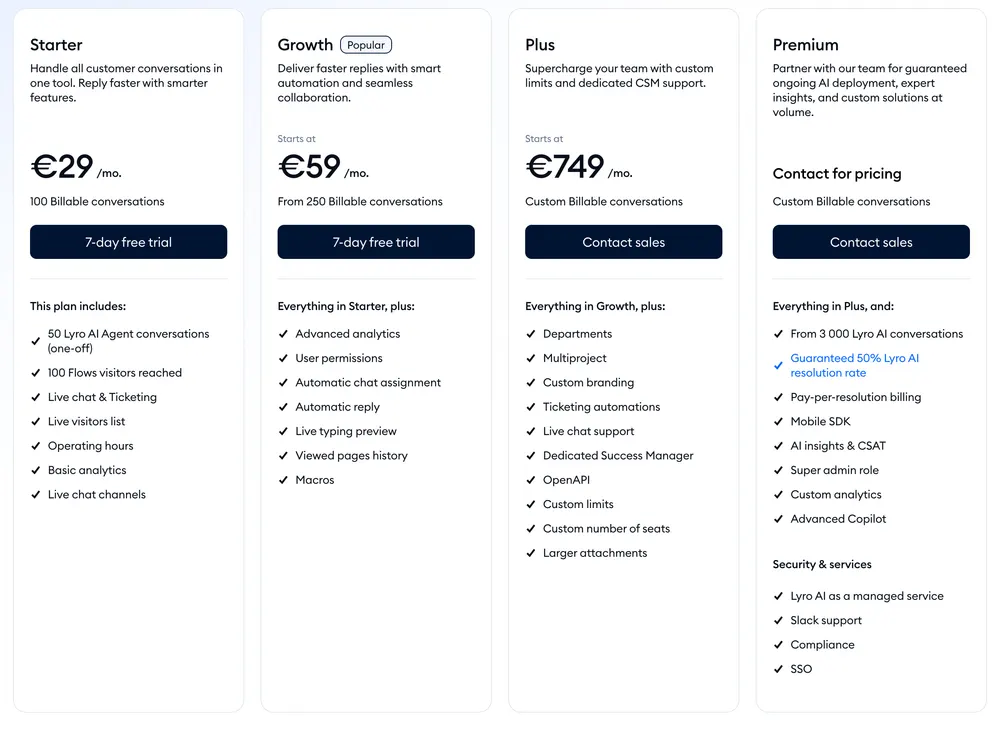
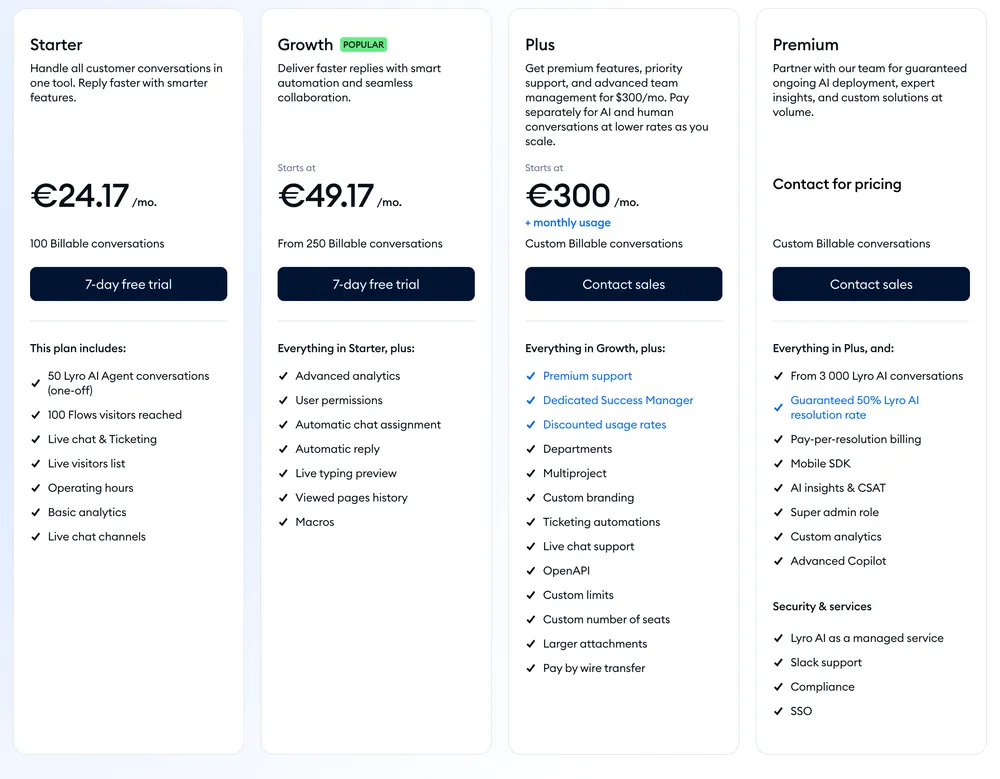
The currency symbol in those screenshots is euros because Tidio picks the symbol from your location. The number does not change with it: Starter is 29 whether the page draws a euro sign or a dollar sign. Tidio’s own Plus blurb gives the game away, quoting “$300/mo” in a panel headed €300. The one region that genuinely pays different figures is Latin America, which has its own lower price list.
The plans
Paid plan and add-on prices on this page are per month, billed annually.
Free — $0/month
The free plan is useful as a real trial, not just a teaser.
Includes:
- Up to 10 operator seats included
- 50 billable conversations/month
- 100 visitors reached via Flows (per month)
- 50 Lyro AI conversations (one-time)
- Live chat widget
- Basic ticketing and help desk
- Email and social messaging integrations
- Basic analytics
- Tidio branding
Best for: Very small businesses, solo operators, and anyone validating fit before paying.
What to watch: Fifty conversations disappears quickly once traffic is real.
Starter — $24.17/month
All plans from Free through Growth include up to 10 operator seats at no extra cost.
Starter gives a little more room, but I would still treat it as a light-use plan.
Includes everything in Free, plus:
- 100 billable conversations/month
- Live visitor list
- Slightly better analytics
Best for: Solo operators with modest support volume.
What to watch: Once you add Lyro and Flows, the practical monthly cost climbs fast.
Growth — from $49.17/month
Growth is the plan most serious small teams will look at first. It starts reasonably, then scales upward with conversation volume.
Includes everything in Starter, plus:
- 250+ billable conversations/month
- Advanced analytics
- Page history per visitor
- Typing preview
- Macros (formerly canned responses)
- Permission controls
- Optional branding removal add-on
Best for: Growing ecommerce stores and lean support teams.
What to watch: Growth still caps out at 10 operators. If your team is growing beyond that, you’ll need to talk to Tidio’s sales team about Plus or Premium options.
Plus — from ~$300/month + usage
Plus is where Tidio moves to higher-volume, usage-based pricing.
Includes everything in Growth, plus:
- Custom conversation quotas
- Custom operator seat count (talk to sales)
- OpenAPI access
- Webhooks
- Ticketing automations
- Multiproject
- Custom branding
- Priority support
- Account management
Best for: Teams that need API access, more seats, or deeper operational support.
What to watch: Plus pricing starts around $300/mo plus usage and is negotiated with Tidio’s sales team, so that floor is just a starting point. If you’re outgrowing Growth, it’s worth having that conversation to see what they can offer for your team size.
Premium — custom pricing (contact sales)
Premium is clearly aimed at enterprise buyers who want a managed rollout and stronger guarantees around AI performance. Pricing is contact-sales, with custom conversation volume, from 3,000 Lyro AI conversations, and a guaranteed 50% Lyro AI resolution rate.
Add-ons
| Add-on | Price/mo | Adds |
|---|---|---|
| Lyro AI Conversations | $32.50 | 50 AI-handled conversations |
| Flows (Visitors Reached) | $24.17 | 2,000 visitors triggered by bots |
| Branding Removal | $16.67 | Removes “Powered by Tidio”; Growth and higher plans |
Lyro is Tidio’s AI layer, and it is priced as a flat monthly fee for a flat quota of AI conversations rather than a pay-as-you-go meter — you move up a tier when you need more volume. These are annual-billing rates; paying month to month costs about 20% more. That layered usage is why the advertised entry price often understates what a working setup will really cost.
The Lyro AI line in that table is the one people most often misread. A few things the headline number hides:
- $32.50/mo is only the first rung. Lyro is a slider, not a fixed add-on. It scales 50 → 1,000 conversations, and the top self-serve stop is $583.33/mo. The per-conversation rate improves slightly as you climb (roughly $0.65 down to $0.58), but the monthly total rises fast.
- The free 50 Lyro conversations are one-time, not monthly. They are a lifetime allowance that does not refresh — the single most common source of surprise in reviews.
- It is a separate meter from your billable (human) conversations. A busy month can eat into both pools at once, so the two add up rather than substitute.
- Above 1,000 conversations there is no published price — it becomes contact-sales, and the highest-volume tier switches from a flat quota to pay-per-resolution billing.
- A “Lyro AI conversation” counts on engagement, not resolution — any conversation where the AI replies at least once, whether or not it solves anything.
For the full slider ladder, annual-equivalent pricing, and the contact-sales tiers, see the dedicated Lyro AI Agent pricing review.
Real-world cost scenarios
Solo founder, ~100 conversations/month, wants basic AI:
- Starter (100 conversations): $24.17/month
- Lyro add-on (50 AI conversations): $32.50/month
- Total: $56.67/month
Small ecommerce team, 8 agents, ~1,000 conversations/month, using Lyro and Flows:
- Growth (1,000 conversations): $149.17/month
- Lyro (100 AI conversations): $62.50/month
- Flows (5,000 visitors): $40.83/month
- Total: $252.50/month
Team that needs more than 10 agents:
- Plus starts from ~$300/mo plus usage; Premium is custom-priced (contact Tidio’s sales team)
- AI and Flows volume is negotiated separately with sales at this tier
What reviewers tend to say about pricing
The positive case is easy to understand: at the lower tiers, Tidio can deliver a lot for the money, especially compared with enterprise-heavy alternatives. The free plan in particular is stronger than many competing entry tiers.
The negative case is just as consistent: pricing can feel opaque once usage starts growing. Complaints often center on upgrade pressure, unclear billing expectations, and auto-renewal frustration.
My overall take is this: Tidio is often good value when you are small, but it becomes much less forgiving once your team, conversation volume, or integration needs grow.
Annual vs. monthly billing
Prices on this page are per month on annual billing. Committing to a year saves roughly 17% (effectively two months free) compared with paying month to month, where Starter is $29/month and Growth starts at $59/month.
Pricing data in the original version of this page was verified against Tidio’s official pricing materials, marketplace listings, and published third-party analyses. I still recommend checking the current pricing page directly before purchasing.